
Checking Criminal History in McHenry County
Start with the question the record must answer. The McHenry County Circuit Clerk Public Access Portal is the main route for filed criminal cases, future dates, case events, amounts due, and a case-linked warrant indicator. The sheriff's hourly inmate reports answer a narrower question about current county custody and releases during the prior three days. An incident narrative remains with the sheriff or municipal police department that wrote it. None of those local sources is a complete Illinois criminal history.
Use a full legal name, date of birth when an official form permits it, old names, and a known case or ticket number. Similar names are common. Match several identifiers and then confirm the result with the office that owns the original file.
- Search the circuit clerk portal when filed charges or a final court outcome matter.
- Check both sheriff inmate PDFs, by name and by date, for recent McHenry County jail custody.
- Request the incident or arrest report from the police agency that created it.
- Use ISP Access and Review with fingerprints to inspect or challenge your own statewide record.
- Order a clerk copy or focused agency record when the online result lacks the needed detail.
One McHenry County Arrest, Four Records
A single McHenry County arrest can create four related files. The arresting agency writes the incident and arrest narrative. The county jail creates a JCA booking entry and custody record. The State's Attorney decides what to file, and the circuit clerk opens the court case. Fingerprints and identifying data then reach the Illinois State Police Bureau of Identification, where the arrest cycle may be matched to a later disposition.
The records may differ without any one of them being wrong. A booking charge states the allegation at intake, while the filed charge reflects the prosecutor's decision. A recent booking can appear before a court case. A disposition may reach ISP later. Compare the stage, custodian, and update time before treating a mismatch as an error.
| Record layer | McHenry County custodian | Best use |
|---|---|---|
| Police narrative | Responding sheriff or city police | What officers reported |
| Booking file | Sheriff Correctional Bureau | Jail intake and custody |
| Court case | Circuit Clerk, 22nd Judicial Circuit | Filed charge and outcome |
| State history | ISP Bureau of Identification | Illinois arrest cycles and reported dispositions |
For a focused review of the court layer, use the McHenry County criminal court cases resource.
Illinois Official Background Checks
The Illinois State Police Bureau of Identification is the central state repository. Illinois conviction information is public under the Uniform Conviction Information Act. A name inquiry can return public conviction information, but name matching is less exact than fingerprints. A person who needs their own full Illinois record and a way to dispute it should use ISP Access and Review. That process has no ISP charge and uses fingerprints to tie the request to the right identity.
CHIRP, the Criminal History Information Response Process, is not a free anonymous people search. It requires an ISP user agreement and Illinois Digital ID. Licensed live-scan vendors provide another official channel and may add a collection fee to the state charge.
| ISP inquiry | Paper/manual | Electronic |
|---|---|---|
| UCIA name inquiry | $16 | $10 |
| Fingerprint-card inquiry | $20 | $15 |
| State and FBI fee-applicant check | $32 | $27 |
The ISP fee schedule shows the source charges and qualifying resubmission rules.
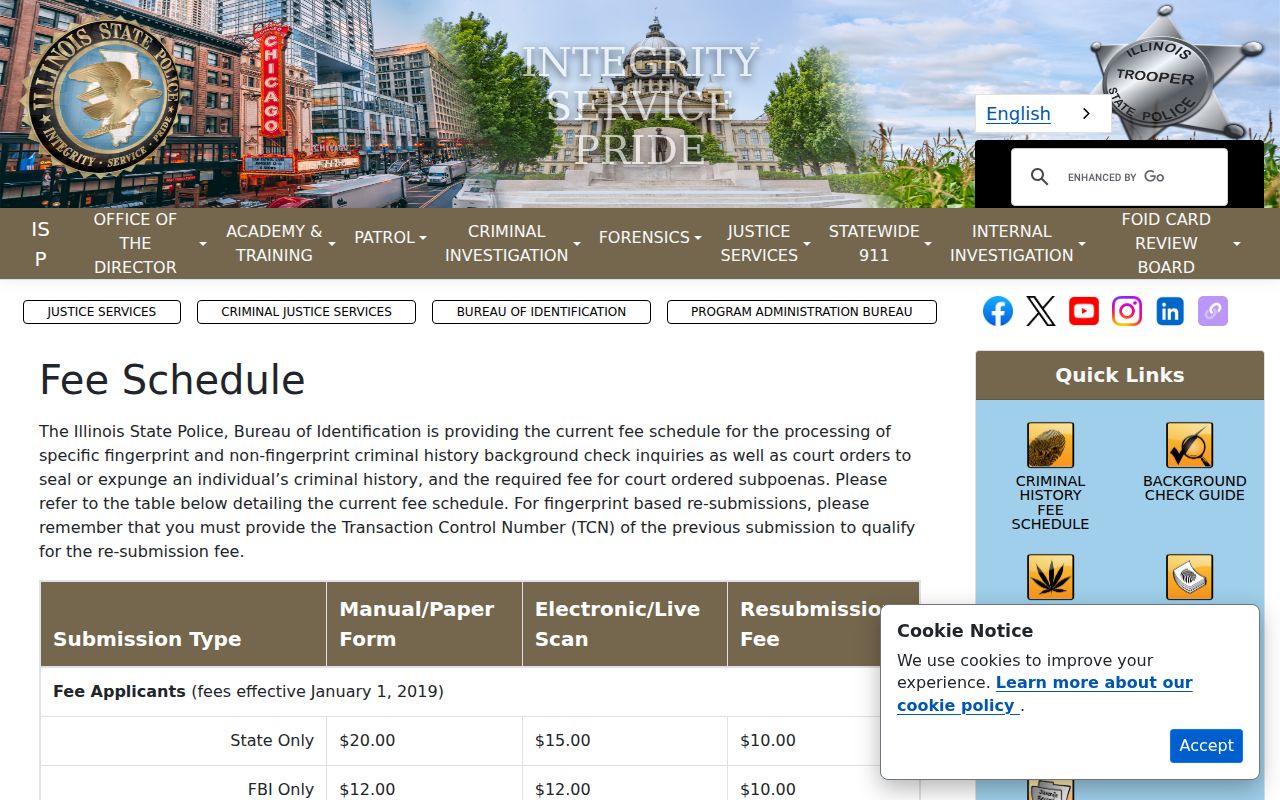
The official schedule helps separate the state fee from any added live-scan vendor charge.
CHIRP and McHenry County Records
The CHIRP login is built for Illinois law-enforcement agencies and entities that have an ISP user's agreement. Users need a Digital ID, and Illinois residents enroll with data that matches a valid state driver's license. Out-of-state users follow a nonresident acceptance route. Responses are encrypted. Those controls make CHIRP quite different from a public county case search.
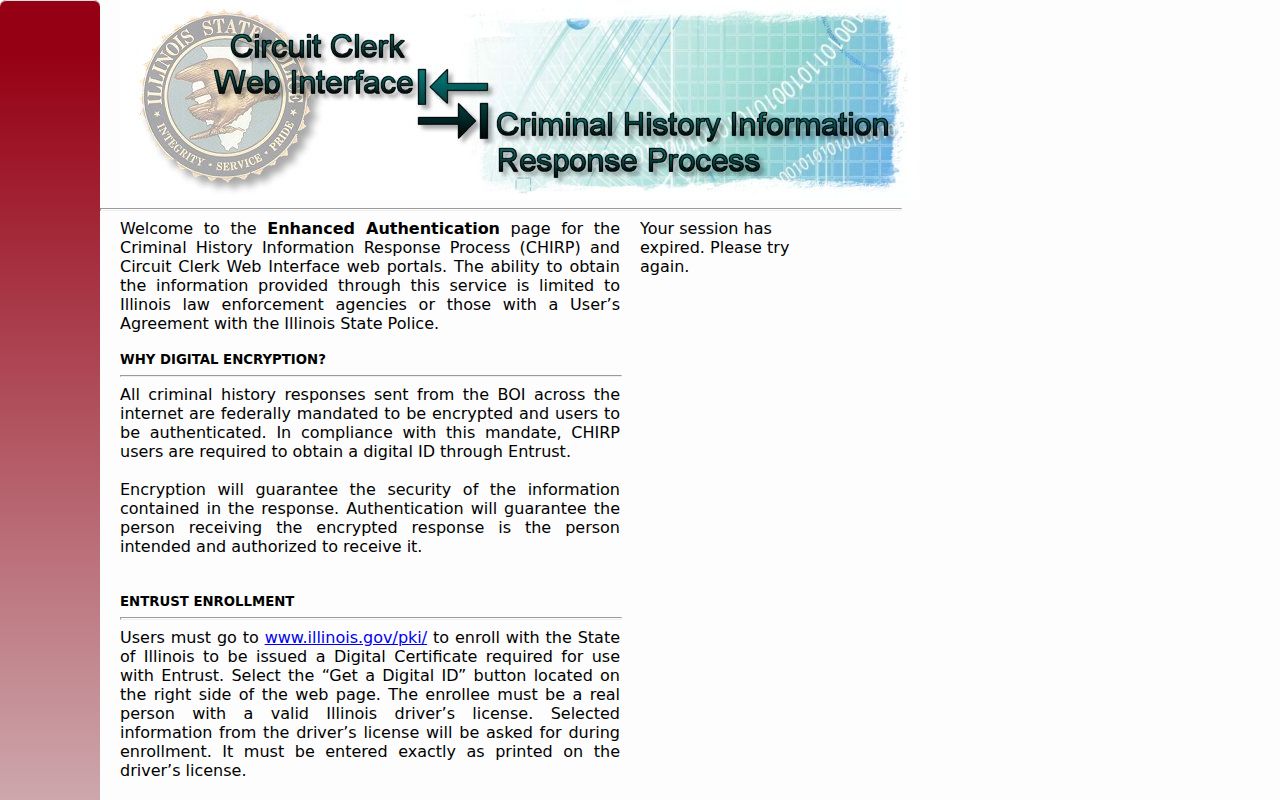
The gate explains why a member of the public should use a licensed vendor or paper UCIA request for conviction information, and ISP Access and Review for their own complete record. A McHenry County clerk search or sheriff record can fill a local need, but neither replaces the statewide repository.
Note: A fingerprint match is stronger than a name match, yet the requested product still controls which information ISP may release.
Criminal Record Types
McHenry County criminal records are separate products with separate access rules. The term “rap sheet” usually points to an identification-linked state history, not every police report or document in a local court file. A warrant is also distinct from a conviction. Choose the source that records the event being checked.
- Incident and arrest reports belong to the sheriff or city police agency that investigated the event.
- Booking records document county jail intake, charge status, court setting, custody, and release.
- Court files show the complaint or indictment, docket events, orders, outcome, sentence, and money due.
- ISP history joins qualifying Illinois arrest cycles with dispositions reported to the state.
- Custody and supervision records split among the sheriff, local Court Services, IDOC, and the Prisoner Review Board.
The IDOC Individual in Custody Search becomes the right source after a person moves to state custody. The ISP registry is a public notification system, not a full criminal-history report.
McHenry County Criminal Records and FOIA
The McHenry County Sheriff's Records Division is the central depository for sheriff arrest, crash, citation, incident, and jail booking records. Its web FOIA form lets a requester describe the record and choose inspection, paper, electronic, certified, or other delivery. Useful identifiers include a report or JCA number, date and location, involved names, and the exact item sought. Asking for a releasable redacted part can help when an active investigation limits a full report.
The sheriff generally has five business days to answer an ordinary Illinois FOIA request, subject to a lawful extension. The first 50 black-and-white pages are free, then copies cost $0.15 per page. Color and electronic media may be charged at actual cost. A commercial request follows different timing rules.
The sheriff's official homepage groups its inmate, FOIA, crime-map, most-wanted, and registry routes.
Those shortcuts point to distinct record systems, so the most-wanted list should never be treated as a complete warrant search.
Inside a McHenry County Criminal Record
The fields change with the record layer. ISP information can include names and aliases, biographical identifiers, state and FBI identifiers, fingerprint-supported arrest cycles, the arresting agency, charges, and matched dispositions. The circuit clerk centers the case number, division, parties, filed charges, judge, hearings, docket events, outcome, sentence, and financial obligations. The jail report centers custody and the next court event.
| Name and identifiers | Legal name, aliases, date of birth, and agency identifiers where release is allowed. |
|---|---|
| Arrest and booking | Confinement time, JCA number, alleged charge, class, case number, and release status. |
| Charges and statutes | Police allegations may differ from the formal charge filed by the State's Attorney. |
| Disposition | Dismissal, nolle prosequi, supervision, acquittal, conviction, or another court result. |
| Sentence | County jail, probation, conditional discharge, fines, restitution, or state custody as ordered. |
| Custody or supervision | Sheriff jail status, local probation, or IDOC custody and mandatory supervised release. |
“Disposition” means the result of a charge. “Nolle prosequi” means the prosecutor chose not to continue it at that time. Neither an arrest nor an indictment is a finding of guilt.
McHenry County Jail Records
The McHenry County jail reports a capacity of 650 and holds people awaiting trial as well as those serving county terms. A sentence longer than 364 days ordinarily sends the person to the Illinois Department of Corrections. That transfer explains why someone may vanish from the local inmate report while the court case remains visible. Search IDOC after a state-prison sentence rather than concluding that custody ended.
The sheriff website posts free inmate PDFs by name and by date, refreshed hourly. They cover adult local-charge inmates and releases during the past three days. Juveniles, federal-only detainees, weekenders, and people temporarily out are excluded. The official “McHenry County Sheriff's Office (IL)” app is advertised as more current than the PDFs. VINE offers custody and release notifications when repeated static checks are not enough.
Note: The jail report has no mugshot, arresting officer, arrest location, medical flags, narrative, warrant number, or victim data.
Public Access Laws in Illinois
Illinois law opens some records while protecting others. FOIA applies to nonexempt records held by executive agencies such as the sheriff. Court files follow court policy and circuit clerk procedures. The Uniform Conviction Information Act makes conviction information held by ISP public, while the Criminal Identification Act governs collection, release, personal access, correction, and record relief. Juvenile, sealed, impounded, medical, and victim-identifying data can remain restricted.
Key Illinois laws:
5 ILCS 140 gives a right to request nonexempt public records and sets agency response rules.
20 ILCS 2635 defines conviction information and permits public ISP conviction inquiries.
20 ILCS 2630 governs Illinois criminal-history data, subject review, corrections, expungement, and sealing.
730 ILCS 152 controls public sex-offender notification information and access.
A denial under FOIA is not always the last step. The Illinois Public Access Counselor accepts eligible review requests about agency responses.
McHenry County Warrant Records
The county State's Attorney routes readers to the circuit clerk portal's “Do I Have A Warrant?” function. That case-linked tool is the best public starting point. The sheriff also posts a Most Wanted list, but it is not a full warrant database. Sealed, juvenile, and not-yet-public warrants will not appear in a normal public search.
If a warrant indicator appears, record the case number and issuing courtroom. Confirm it through the official case or court channel, speak with counsel, and follow the court's directions. Do not assume that a payment alone recalls a warrant until the court has entered the proper order and the systems show it cleared. A bench warrant is usually tied to failure to appear or comply; an arrest warrant rests on probable cause; a search warrant is not a public person-lookup product.
McHenry County has one unified Circuit Court, not separate city criminal courts. Advice to call a municipal court for every local warrant does not fit Illinois structure.
Sealed, Expunged, and Restricted Records
Illinois expungement and sealing have different effects. Expungement destroys, returns, or obliterates eligible police and court records as the statute provides. Sealing keeps a qualifying record but removes it from ordinary public view, while access authorized by law remains. A dismissal or completed supervision does not erase a McHenry County portal entry by itself. Eligibility depends on the outcome, sentence, offense, waiting period, and prior record.
Petitions are filed with the McHenry County Circuit Clerk. Research for the county identifies a $60 circuit clerk filing fee plus $155 payable to the clerk for Illinois State Police processing, a total of $215 before any added local notice or copy cost. ISP lists an $18 order-processing charge, which the clerk's collection covers through the local workflow. The Office of the State Appellate Defender provides statewide forms and record-clearing information.
Juvenile, sealed, mental-health, and impounded matters may not show in the public portal. A blank web result is not proof that no record exists or that relief was granted.
Why Woodstock Holds County Records
Woodstock is the McHenry County seat and justice-record hub, even though Crystal Lake is the largest city. The first county Circuit Court term opened in McHenry in 1838. An effort to shift the seat toward the rail junction near Crystal Lake later failed at referendum, with 2,095 votes against and 1,049 for. The county then built its 1857 Woodstock courthouse.
The modern Route 47 campus followed a 21-acre purchase in 1969 and groundbreaking in 1971. A major 1990-92 expansion joined the Government Center, court, jail, prosecution, defense, and supervision offices in one complex. They remain separate legal custodians despite sharing an address. A requester still must choose the circuit clerk for a case filing, the sheriff for its police or jail record, and Court Services for personal probation business.
Judicial Center
2200 N. Seminary Ave.
Woodstock, IL 60098
815-334-4000
Sheriff Records
2200 N. Seminary Ave.
Woodstock, IL 60098
815-338-2144
Probation and Court Services
Room 240, 2200 N. Seminary Ave.
Woodstock, IL 60098
815-334-4400
McHenry County Probation Records
McHenry County Probation and Court Services supervises adult and juvenile probation after sentence in the 22nd Judicial Circuit. During the first 90-day intake phase, county guidance says clients ordinarily report every two weeks. Later contact can range from weekly to every six months based on risk and court conditions. Court Monitoring uses an intake interview and tracks compliance for supervision and conditional-discharge cases.
Pretrial supervision is different. The Illinois Office of Statewide Pretrial Services handles adult pretrial cases, while local Court Services manages monitoring equipment. Published daily adult charges are $5 for electronic monitoring or house arrest and $8.50 for GPS; juvenile monitoring has no fee, and assessed costs are waived for an acquitted adult. State-prison parole or mandatory supervised release is handled by IDOC, with conditions set by the Illinois Prisoner Review Board.
The court docket can show the sentence and later violation petitions. Detailed risk assessments, treatment records, and officer notes are not a public online status database.
McHenry County Criminal Records by City
City police keep their own incident and arrest narratives, even when a person later enters the McHenry County jail. Filed criminal charges from Crystal Lake, Algonquin's McHenry County side, and Lake in the Hills flow to the unified 22nd Judicial Circuit rather than separate municipal criminal courts. The city record channel matters most for the police report; sheriff and clerk systems supply the county booking and court layers.
Crystal Lake Criminal Records
42,288 residents · Police Records Unit and Citizen Support Center requests
Algonquin Criminal Records
30,824 residents · NextRequest with county-side routing
Lake in the Hills Criminal Records
28,590 residents · JustFOIA police-record request channel
The population figures are July 1, 2025 Census estimates. Algonquin spans McHenry and Kane Counties, so the incident location determines which circuit and agency hold the record.