
Checking Algonquin Criminal Records
Begin with Algonquin Police when the request concerns a village incident, arrest, citation, or crash. Then read the report or citation for the county of occurrence. McHenry-side filed cases route to the Twenty-Second Judicial Circuit. Kane-side cases use the Kane County circuit system. A person actually delivered to McHenry County jail can have a Sheriff booking record, but not every Algonquin arrest follows that route.
- Identify the Algonquin event date, location, report number, and record type.
- Submit a focused police request through NextRequest or a village fallback channel.
- Confirm whether the event occurred in McHenry or Kane County.
- Use the matching circuit clerk and, when relevant, the jail that booked the person.
- Use ISP Access and Review with fingerprints to inspect or challenge your own Illinois record.
Algonquin NextRequest Portal
The village prefers its NextRequest portal. The online form is account-gated, so its exact labels are visible after sign-in. A requester should identify the record with enough detail for staff to locate it and provide usable contact and response information. Illinois law does not require use of a prescribed form, which keeps email, fax, mail, and counter delivery available.
The official portal screen shows where Algonquin requests begin.
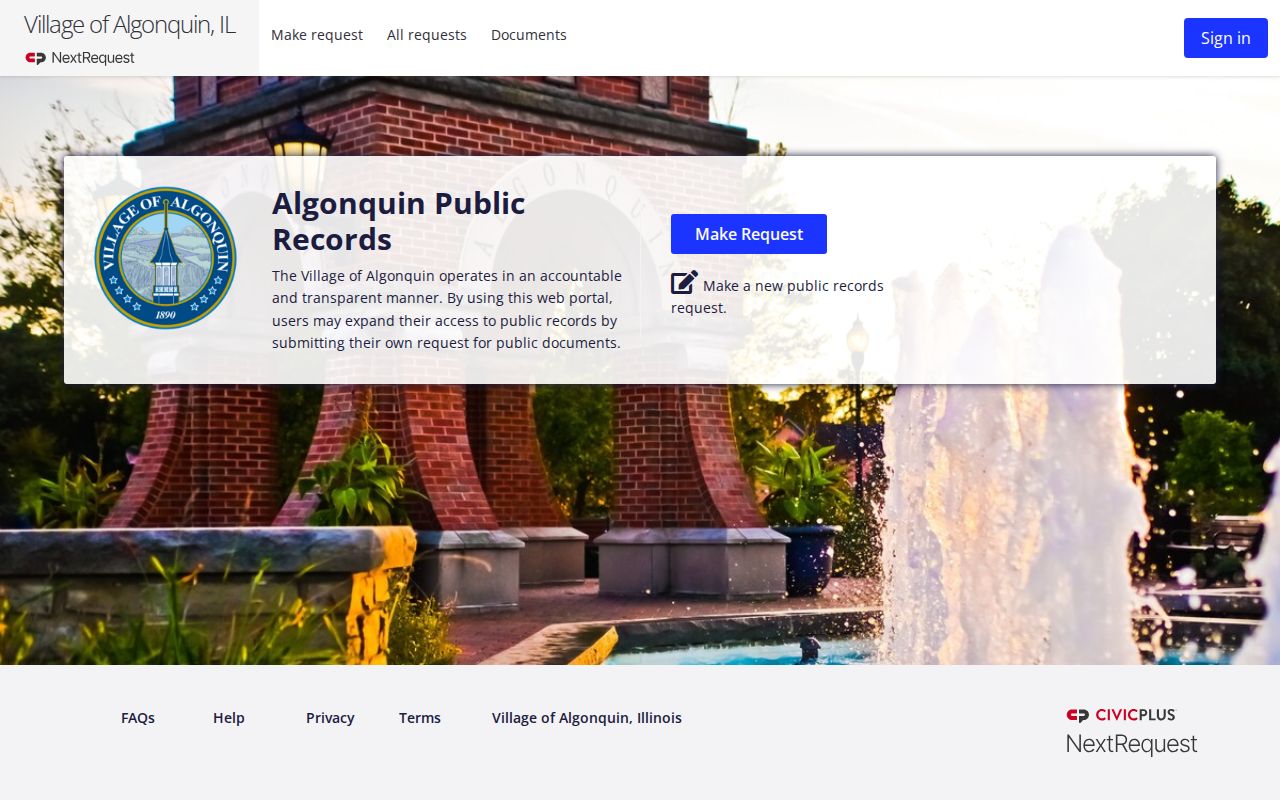
NextRequest gives the village one place to receive and track a request, but it does not turn police files into an unrestricted name database. Access still depends on the record, the requester's involvement, and lawful redactions.
Algonquin Police Records
The Algonquin Police Department operates from the Ganek Municipal Center at 2200 Harnish Drive, Algonquin, IL 60102. Its nonemergency number is 847-658-4531. The village identifies Sgt. Timothy Cooney as the current police deputy FOIA officer. Police records should be requested from the village rather than assumed to be held by either county sheriff.
Report access can depend on the requester's involvement and on legal exemptions. A focused request should state the incident date, place, report number, involved party, and exact record sought. Algonquin may redact personal, juvenile, investigative, or other protected material while releasing nonexempt portions.
Algonquin FOIA Request Options
Requests may also go to foia@algonquin.org or reach the Village FOIA Officer by fax, mail, or in person. The village FOIA information page explains that a written request need not use one mandatory form. Describe the report, date, location, and involved party clearly. Police-report availability can depend on how the requester relates to the event.
The village's public FOIA page provides the official alternative when the account portal is not the right fit.
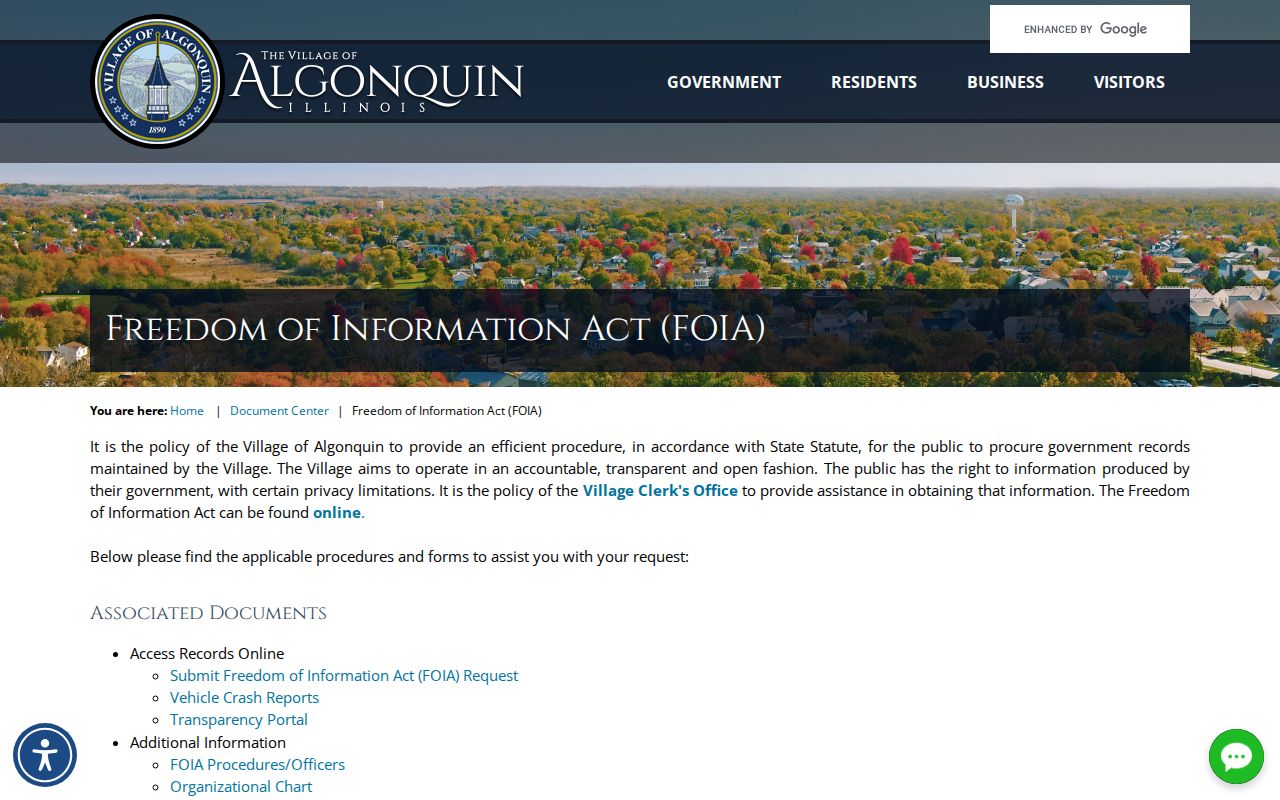
General requests use a five-business-day response period, subject to lawful extensions, while commercial requests use 21 business days. Court copies are not obtained through village FOIA because the circuit clerk, not Algonquin, holds the case file.
Algonquin Arrests and Bookings
An Algonquin arrest first creates a village police record. If the person is delivered to McHenry County jail, the Sheriff creates a separate booking record with custody, charge, case, court, and release fields. The research does not support a claim that every village arrest goes to that jail. Geography, custody decisions, and the handling agency all matter.
A citation and release may produce no county booking entry. Search Algonquin Police for the event report, then use the correct court once charges are filed. A booking charge is not necessarily the final filed charge, and an arrest is not proof of guilt.
Algonquin Two-County Record Route
The whole village population and Algonquin Police service area cross a county line. That makes the event address a key search field. A McHenry County home address does not prove that every Algonquin citation or police event belongs in McHenry court. Read the citation, report heading, or filed case information for the county tied to the event.
For McHenry-side cases, use the Twenty-Second Circuit Public Access Portal. Kane-side cases may appear through Kane County's circuit system. If the location is unclear, start with Algonquin Police and ask for the city report. It can supply the basic event facts needed to select the right clerk.
Algonquin Municipal Case Records
Algonquin does not run a separate municipal criminal court. Illinois trial matters are heard in circuit courts, including ordinance, traffic, misdemeanor, and felony cases. The event county controls the route. McHenry-side cases use the Twenty-Second Judicial Circuit, while Kane-side matters may appear in the Kane County circuit system. Confirm the county from the citation or police report before searching.
| Court Name | McHenry County 22nd Circuit or Kane County Circuit Court, based on event location |
|---|---|
| Case Types Heard | Ordinance, traffic, misdemeanor, felony, juvenile, and other trial matters |
| Case Lookup Channel | The circuit clerk portal and copy process for the correct county |
| What the Docket Shows | Filed charges, case events, dates, judge, courtroom, outcome, sentence, and public balances |
| Copies & Fees | The selected circuit clerk's current copy rules and fees |
Algonquin Record Copy Fees
The village publishes distinct charges for different copy formats. Reviewing the records in person or asking for electronic delivery may help a requester select only the pages needed. The official schedule should be checked before a large request because actual work and format can affect the final amount.
| Algonquin copy item | Official fee |
|---|---|
| 8.5 x 11 black-and-white | $0.10 per double-sided page |
| 8.5 x 11 color | $0.18 per double-sided page |
| Large format over 17 inches | $3 per page |
| CD-ROM | $2 |
| Email copies | No charge unless copying or scanning is needed |
| Certified record | $1 |
These village fees do not govern a McHenry or Kane circuit clerk, a county jail record, or an ISP criminal-history request. Each custodian applies its own current schedule.
Where Algonquin Records Go
Algonquin Police creates the report. A jail creates a booking file if the person enters custody. The prosecutor and circuit clerk in the event county create and maintain the filed case. Qualifying arrest data and court dispositions then move to the Illinois State Police Bureau of Identification, where they can be matched to a state identification record.
Record flow: Algonquin Police › Correct County Circuit Court › Illinois State Police Bureau of Identification
A new police event may precede a court filing, while an older disposition can take time to match at ISP. Check the source closest to the event first and preserve both the police report number and court case number.
Algonquin Police Activity Context
An official February 2025 manager report compared January and February year-to-date activity. It listed 2,813 calls for service in 2025 versus 2,547 in 2024, along with 1,786 traffic, parking, and ordinance citations versus 529. Crashes numbered 149 versus 171, vacation watches 1,416 versus 1,168, and directed patrols 4,671 versus 4,716.
Those measures describe workload and enforcement, not crimes known to police and not convictions. A call can close without an arrest. A citation may not lead to jail intake. Directed patrols and vacation watches are service activity. Use the individual Algonquin report and the correct court outcome to understand one event instead of treating a broad activity count as a criminal-record total.
The sharp rise in the combined traffic, parking, and ordinance citation measure also needs care. That category joins several types of enforcement activity and does not show how many people were arrested or convicted. The same report shows crashes fell during the comparison period while calls for service rose. For a specific Algonquin event, the police report and citation supply the underlying facts, and the proper county court supplies the filed result.
Algonquin Police Record History
Algonquin's official history describes the village as the Gem of the Fox River Valley. Settlement began in 1834, the community gained its official name in 1847, the railroad arrived in 1855, and incorporation followed in 1890. Old Town contains more than 300 structures and sites, and nationally attended hill climbs ran from 1906 through 1913.
The Historic Village Hall once contained a marshal's office and jail. Modern custody no longer follows that old local model. Algonquin Police creates the city record, while present-day bookings and criminal cases route outward to the proper county institutions. The shift is a useful reminder that the village police file and county court file remain separate records.
The village's early development predates both its modern police portal and the present county court systems. Old Town's large stock of historic sites can create a separate records need for researchers tracing a place or civic event rather than a current criminal case. Those historical questions should begin with the village's official history resources. Current incident, booking, and court questions remain with the modern custodians named above.
Algonquin Police Source Check
The official police hub is the best place to confirm current department contact details before sending a request.
The Algonquin Police page identifies the department source used for village-level police records.
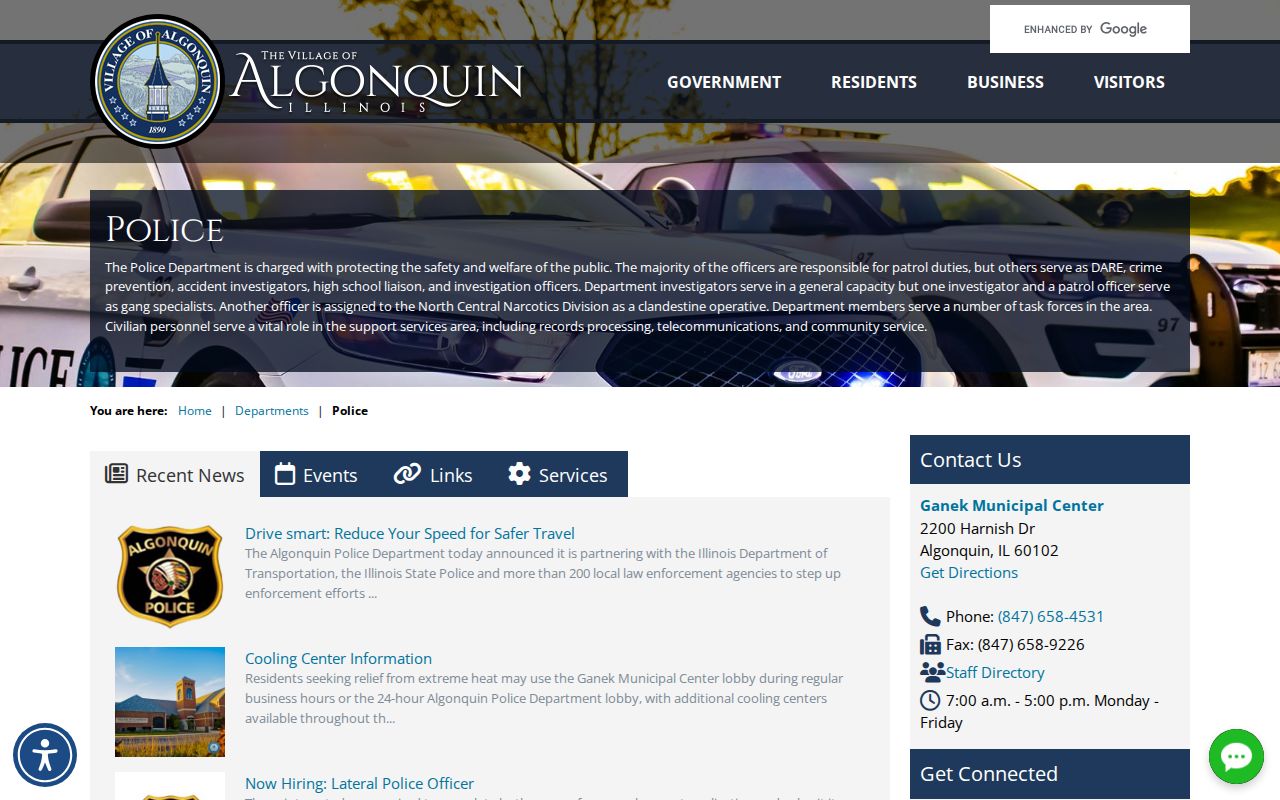
Agency pages and forms can change. Confirm the listed office, delivery channel, and current FOIA officer when a request is time-sensitive, then retain the confirmation or tracking message with the report number.
Missing Algonquin Criminal Records
A blank search should trigger a route check, not a quick conclusion. Confirm the spelling, event date, street, and reporting agency. Then determine whether the site lies in McHenry or Kane County. A citation and release may never create a jail booking, and a new police report may exist before prosecutors file a case. Algonquin Police can address the city report, while the correct circuit clerk can address the case file. A county jail report is a short custody view, not a lasting village arrest archive.
Next, compare identifiers. The police report number belongs with the village. The court case number belongs with the circuit clerk. A state identification record uses fingerprint-supported data and may include aliases. If the court outcome is missing from your own Illinois record, use ISP Access and Review and contact the reporting court or agency when needed. Name matching alone can confuse two people or miss an alias, while fingerprints identify the subject more reliably.
Restricted access is another possible cause. Juvenile records are not ordinary adult portal records. Sealed records remain available only to authorized parties, while expungement removes eligible police and court records as Illinois law directs. Active investigations and private data can be redacted from an Algonquin response. An image-only or older court document may require a clerk copy request even when the public docket has limited detail.
Keep each official response with its tracking key, report number, or case number. If the village says it holds no responsive record, review whether another police agency handled the call or whether the requested item is actually a court or jail record. If the result is disputed, seek correction from the custodian that created the faulty data before expecting a downstream state record to change. This method preserves the line between no record, no public web display, and a record that exists but is restricted.
A public conviction inquiry is also narrower than a subject's full record. CHIRP requires an ISP user agreement and Illinois Digital ID, so it is not an anonymous public people-search screen. Algonquin residents reviewing their own history should use the official Access and Review route instead of treating a local portal or public name response as a complete rap sheet.
Algonquin Public Access Rules
Illinois FOIA applies to releasable Algonquin executive-branch records, including police records subject to exemptions. Court records use court access rules and the correct circuit clerk's procedures. ISP conviction information and a person's own state record follow separate Illinois statutes. A denial should identify the exemption and preserve access to reasonably separable nonexempt material.
Key Statutes:
Illinois Freedom of Information Act, 5 ILCS 140 provides access to nonexempt village records and sets response procedures.
Uniform Conviction Information Act, 20 ILCS 2635 governs public conviction information held by ISP.
Criminal Identification Act, 20 ILCS 2630 governs state collection, access, correction, expungement, and sealing.